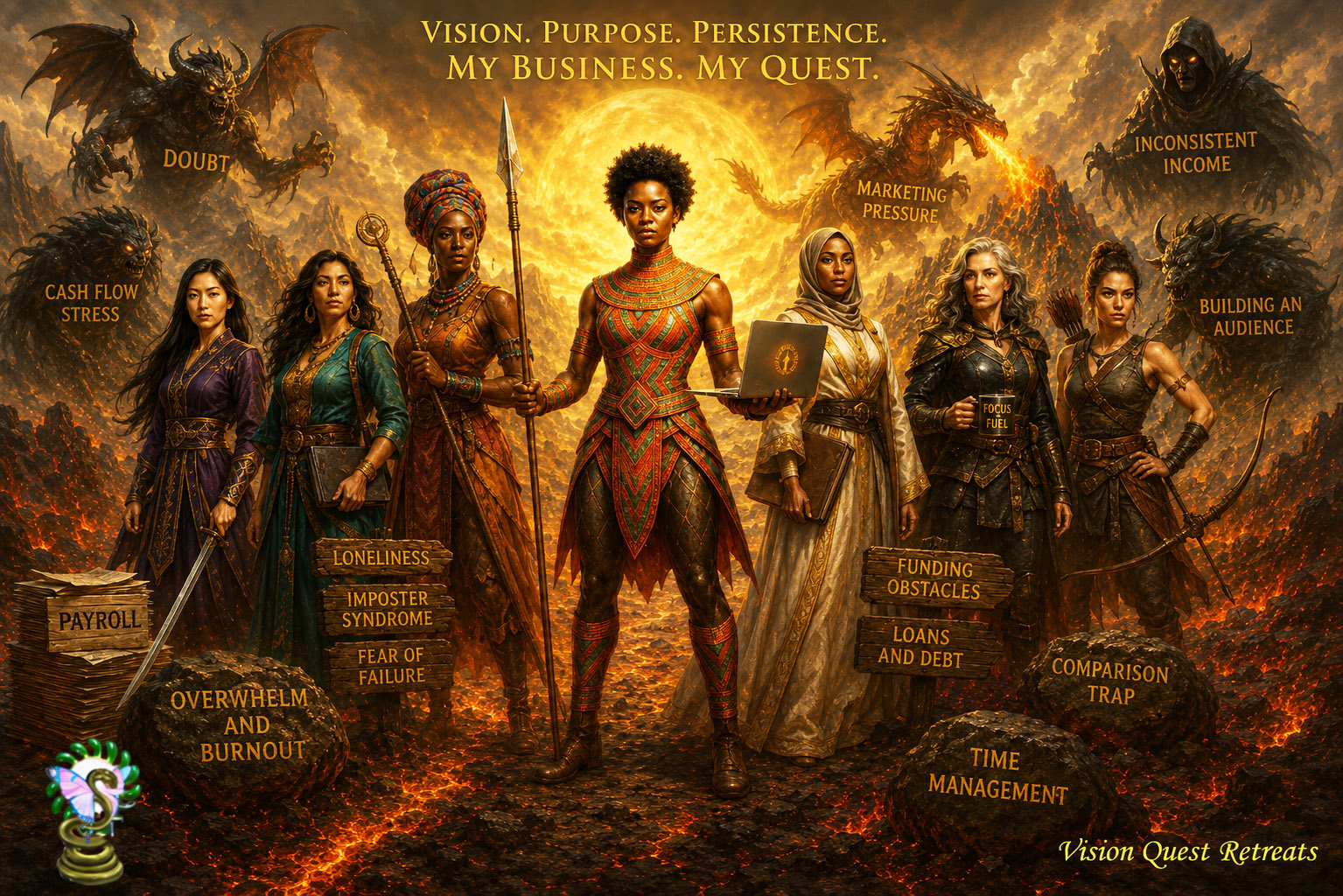

I’ve written a great deal about what it takes to embrace the Heroine’s Quest, fulfill your mission, and live your vision of success.
Heed the Call to Adventure. Have courage. Believe in yourself. Set goals. Take risks. Defeat Threshold Guardians.
All of that is necessary.
But what happens when the greatest obstacle to fulfilling your mission and living your vision permeates the very air you breathe, and the water you took your first bath in? What happens when you belong to a family system that has already decided what your life’s purpose and story are supposed to be?
I have been struggling with this question personally, viewing it through the framework of the Heroine’s Quest: the journey of recognizing the call toward the life you envision for yourself, pursuing your mission through your work, and finding the courage to overcome the obstacles that stand in your way. Increasingly, I have come to understand that sometimes answering that call requires something much more disruptive than overcoming fear.
Sometimes you have to resist an entire system and refuse the role that system assigns to you.
When Your Life Has Already Been Assigned a Purpose
For much of my life, I have resisted the traditional gender-role expectations of my family.
Not quietly, either. My resistance was demonstrated and articulated.
I have repeatedly called out the inequity and said that I do not see myself primarily as a caretaker, an assistant, background player, or facilitator of someone else’s life and vision. I am much more naturally oriented toward leadership, creation, independence, and meaningful work. I have always wanted the freedom to devote substantial energy to what I believe I am here to create and contribute. Furthermore, anyone with eyes could see that, from childhood, I was bold, independent, strong-willed, and naturally inclined to take the lead. Many people who have known me since I was a little girl have reflected this back to me, remembering that I always seemed to know exactly what I wanted to do and where I wanted to go.
And yet there is an enormous difference between intellectually rejecting a role and actually escaping a system organized around your occupying it.
In many traditional family systems, such as the one I was raised in, men and women are granted very different relationships to ambition.
A man’s work can be understood as a legitimate reason for his unavailability for much else. His concentration is protected because his work is important. His responsibility to others may even be defined largely through that work: he is providing for his family, and therefore focusing intensely on his career is itself considered an act of caretaking.
Women are frequently given a different assignment.
Having a career is encouraged. In fact, it’s also expected that we should be successful at work, our accomplishments may even be admired (or at least bragged about). But underneath that expectation remains an assumption that our work must coexist with an almost unlimited availability to other people. Therefore, our work is interruptible and presumed to have flexible hours.
You can build your business, write your books, make your art, earn your living, or answer whatever call has been placed upon your life. But first, take care of someone else. That someone else can be your husband (not wife, they don’t get caretaking) or your children, siblings or parents.
And somehow, you are expected to remain in a near-constant state of thinking about other people and their needs. Outside of that, of course, you are still expected to be successful and support yourself.
The Difference Between Care and Compulsory Caretaking
I don’t find anything inherently oppressive about caring for other people. As a matter of fact, my desire to care for and protect those I love comes naturally.
That is very different from having caretaking assigned to you because of your gender, your birth order, your marital/child status, your perceived competence, or simply because everyone has become accustomed to your doing it.
A role freely chosen can be part of your vision.
A role imposed upon you can become an obstacle to one.
Single women without children can be particularly vulnerable to this peculiar calculus. Because we don’t have husbands/spouses or children whose needs are culturally recognized as legitimate claims upon our time, our time and emotional energy are thought to be available and communal.
Our work, rest, solitude, creativity, and even the time required simply to think and build our own lives can be treated as optional and flexible. You may have to make a case to prove why what you are doing shouldn’t be moved. In the meantime, the males in the family are not only not expected to care for anyone outside of making money, but they aren’t even called on because, well, “He’s working.” Have I mentioned that I work to support myself and that I work for myself, so when I’m not working I’m not making money?
When Competence Becomes a Trap
There is another paradox in these systems: competence can work against you.
If you manage your responsibilities, support yourself, solve problems, show up in emergencies, and repeatedly figure things out, the conclusion is rarely, “She is carrying a tremendous amount. How can we lighten her load?”
Instead, competence can become evidence that you can carry more.
Meanwhile, the family member who appears less capable, is less available, more volatile, or simply less willing is often asked to do less or nothing at all.
Eventually, what began as helping becomes a job no one admits you have.
And because you perform that job successfully, the system can become almost incapable of seeing its cost.
When the Reward Is the Absence of Punishment
Perhaps one of the most corrosive features of an imposed role is that there may be remarkably little acknowledgment and no appreciation for performing it.
You may sacrifice time, money, energy, opportunities, creative attention, and emotional bandwidth. But because the sacrifice itself is embedded in the role assigned to you, it becomes invisible.
Your “reward” is often simply the absence of punishment.
No criticism (at least for not fulfilling the role. Criticism, in my case, comes WHILE fulfilling it).
No suggestion that you have failed someone.
You have successfully kept the system comfortable.
Until the next thing is required.
Systems Do Not Release the Person Who Wants to Leave
This is where things become more complicated than advice to “set boundaries.”
Family systems, like all systems, develop equilibrium. People occupy roles, often for life. Expectations form around those roles. Other people make choices based upon the assumption that those arrangements will continue.
When one person in the system changes or steps out of their role, everybody else is affected.
If I stop being endlessly available, someone else may need to rearrange their schedule.
But if we do stop organizing, remembering, accommodating, smoothing over, rescuing, transporting, reassuring, or fixing, the emotional and physical labor does not magically disappear.
It must go somewhere else. But here’s the thing: all systems resist change.
That means the other members of the system have very little incentive to encourage, applaud or even accept your liberation.
Your freedom, and your desire for equity may create inconvenience for them.
This is why repeatedly explaining yourself may accomplish surprisingly little.
You can explain that you’re exhausted.
You can explain that the arrangement is inequitable.
You can explain that you have dreams of your own.
And eventually you may confront a difficult truth:
The problem may not be that they don’t understand you.
They may understand perfectly well, but the existing arrangement simply works better for them!
The Exhaustion of Perpetual Resistance
There is also a cost to spending decades fighting a role you never accepted. Trust me, I know. Try 40 years.
My resistance began long before I had a vision or mission to protect. By my early teens, I was already speaking up about the inequity I saw, telling my mother that the role being prescribed to me did not fit who I was and, perhaps more importantly, that being continually pushed into it was hurtful. I wasn’t silent about any of this. I have been resisting it for most of my life.
But resistance requires energy both emotional and physical.
In my adulthood, I have been trying to pursue my vision while simultaneously defending its legitimacy.
I have been trying to create while explaining why I deserve time to create.
I have been trying to rest while defending my right to rest.
I have been trying to concentrate while remaining psychologically alert to the next demand.
I have been trying to become myself while receiving continual messages, subtle and explicit, that the person I am is somehow failing at being the person I was supposed to be.
That is exhausting.
And I have come to understand that burnout may not come simply from doing too much.
It can come from living too long in the space between compliance and rebellion.
I haven’t surrendered my vision.
But I haven’t fully protected it either.
Instead, I have attempted to compromise.
In the language of the Heroine’s Quest, I have been trying to keep one foot in the Ordinary World while embarking on the quest with the other. The role my family system assigned me belongs to that Ordinary World: the familiar expectations, prescribed roles, and status quo I have been resisting since I was young. I have been trying to answer the Call to Adventure while continuing to occupy the very role I am being called to leave.
And I am beginning to understand that this may be the fundamental problem with the compromise. You cannot fully leave the Ordinary World while continuing to live by its rules.
I have helped. Accommodated. Explained. Negotiated. Railed and yelled. Tried not to hurt anyone. Tried to maintain the relationships. I have tried to fulfill enough of the old role to keep the system functioning while preserving enough of myself to build the life I actually want.
And I have finally reached the point of recognizing that the compromise itself is consuming the energy my vision requires.
If this has been your experience too, perhaps you have reached, or are approaching, the same difficult realization: you cannot build the life you are meant to live entirely out of whatever remains of you after you have fulfilled the role others have assigned you.
Sometimes the Heroine Has to Stop Negotiating
This is the place I find myself in now.
What happens when you are no longer willing to spend the remainder of your life wasting precious energy proving that your life belongs to you?
There comes a point in some heroine’s journeys when the task is no longer getting the system to understand and accommodate her.
The task is accepting that it may never accommodate her.
And then choosing your vision and your mission anyway.
That doesn’t necessarily mean abandoning everyone you love. It doesn’t require becoming uncaring, irresponsible, or cruel.
It means ending the assumption that your life must be organized around other people’s expectations and needs.
It means helping because you consciously choose to help, not because your gender or family role has made your availability compulsory.
It means recognizing that your work deserves to be protected not only because it is how you support yourself, but because it is how you fulfill your purpose and accomplish your mission here on Earth.
Your time cannot simultaneously be treated as freely available for caretaking while you remain solely responsible for earning the money required to sustain your own life.
It means understanding that rest does not require justification.
It means refusing the idea that another person’s disappointment automatically constitutes evidence that you have done something wrong and must fix it.
And it may mean allowing other people to experience the consequences of your no and their treatment of you.
The Call to Adventure Is Still Waiting
One of the painful things about spending years negotiating with an oppressive system and role within that system is realizing how much energy the negotiation itself has consumed.
There can be grief in that realization.
There can also be anger.
But neither has to be the end of the story.
On the Heroine’s Quest, the call does not disappear simply because we have delayed answering it. In fact, it may become louder.
Sometimes exhaustion itself becomes information.
The burnout says: I cannot keep living this way.
The anger says: Something I value is being violated.
The resentment says: I have been giving something I no longer consent to give.
And the persistent pull toward my vision says: There is still a life I am meant to live and a mission I am here to fulfill.
Perhaps that is why sometimes the heroine’s journey eventually requires a more radical decision.
Not: How can I pursue my vision while continuing to fulfill the role everyone else has assigned me?
But:
What if fulfilling that role is precisely what I have to stop doing in order to pursue my vision?
For some of us, that may be the threshold we now find ourselves facing on our Heroine’s Quest, the one we must cross to continue the journey.
We can continue trying to make ourselves fit inside a system that was never designed for who we actually are, keeping one foot planted in the Ordinary World.
Or we can cross the threshold once and for all.
Not because we don’t love anyone.
Not because nobody else matters.
But because our lives matter, too.
And at some point, the heroine must decide that the Call to Adventure, the call toward the life she is meant to live and the mission she is here to fulfill, deserves more than whatever energy is left over after everyone else has been served.