Over the past several months, I’ve noticed a recurring theme in my success coaching practice.
As many of you know, much of my work as a psychologist and success coach centers on helping women clarify their vision, navigate major life transitions, and create lives and work that are deeply aligned with their values and purpose.
Over the past several months, a recurring theme has emerged in many of my success coaching conversations. More and more women have stepped into entrepreneurship. Some have pursued businesses they’ve dreamed about for years. Others have found themselves reimagining their careers after organizational restructuring, layoffs, or discovering that the traditional path no longer offered the opportunities or fulfillment they were seeking.
Although their stories are different, many eventually arrive at the same place: navigating the psychological challenges of building something entirely their own.
The numbers suggest this isn’t an isolated experience.
The Numbers Tell an Interesting Story
- Women now own more than 40% of all businesses in the United States.
- Approximately 14.5 million women-owned businesses generate $3.3 trillion in annual revenue and employ nearly 12.9 million people.
- Between 2022 and 2025, the number of women-owned businesses grew by 12%—nearly twice the growth rate of businesses owned by men.
- Women entrepreneurs were responsible for nearly 49% of all new businesses created between 2019 and 2024, representing a 69% increase in new business creation.
- Growth has been especially strong among women of color, with Black women-owned businesses experiencing particularly significant gains in recent years.
At the same time, workforce changes, including reductions across portions of the federal workforce and a more competitive job market, have prompted many professionals to rethink not only where they work, but how they work. Because Black women have historically been well represented in public-sector employment, many have been disproportionately affected by these shifts, leading some to explore entrepreneurship as one path forward.
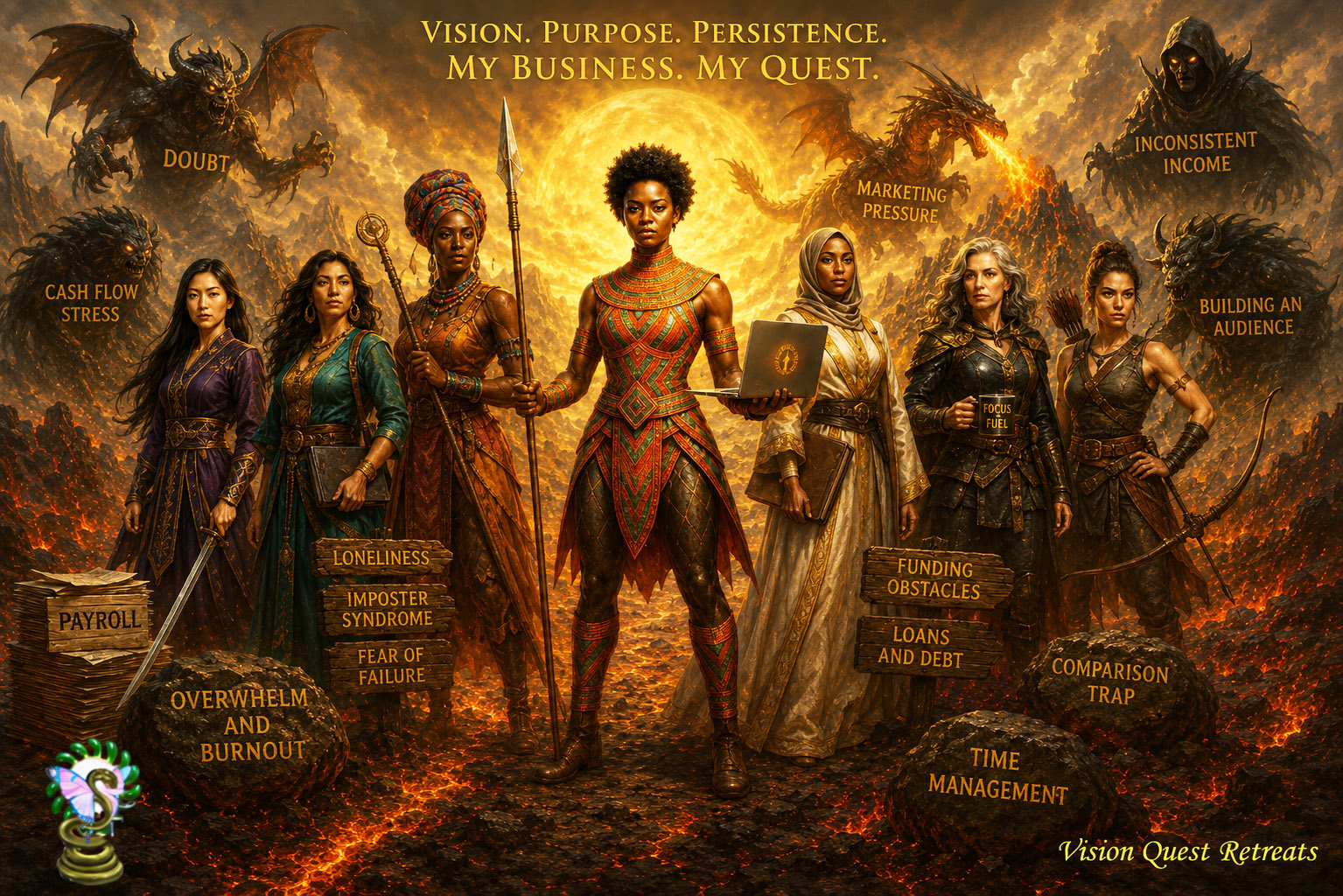
As I listen to the women I coach, I find myself thinking less about business plans and marketing strategies and more about mythology. Over the years, I’ve found that one of the most powerful ways to help people make sense of major life transitions is through the lens of the Heroine’s Quest.
In both my therapy and success coaching practices, I often use the Heroine’s Quest as a framework to help clients understand personal and professional transformation. It reminds us that growth rarely comes from following an established path. It comes from leaving the familiar, navigating uncertainty, and returning transformed.
The entrepreneurial journey has much in common with the Heroine’s Quest. Both begin by leaving the familiar behind. Both require us to forge a path where no roadmap exists. Both are filled with unexpected twists, setbacks, discoveries, and moments of profound growth. And in both journeys, success depends less on avoiding uncertainty than on learning to navigate it.
The Ordinary World

Every Heroine’s Quest begins in the Ordinary World. For entrepreneurs, that world often consisted of a job: established organizations with job descriptions, a defined career ladder, performance evaluations, promotions, paychecks. In other words, someone else had already built the framework. Even if that world wasn’t perfect, its rules were familiar.
Then something changes.
The Call to Adventure
For some women the call has always been there, a desire to create something of their own, to build a business aligned with their values, passions, and vision. For others it arrived unexpectedly through layoffs, restructuring, or changing opportunities. The realization that the path they expected to continue on no longer feels available, or no longer feels right.

The call doesn’t promise that the journey will be easy.
It simply asks whether we’re willing to answer it.
Crossing the Threshold
The moment you commit to building something of your own, you cross a threshold.
For some women, that threshold feels exhilarating.
Freedom.
Creativity.
Autonomy.
Finally creating work that reflects who they truly are.
For others, particularly those who have spent years succeeding in structured organizations—the transition feels much less comfortable.
Without realizing it, they’ve also left behind familiar systems, established expectations, and someone else’s roadmap.
The threshold into entrepreneurship isn’t simply a business transition.
It’s a psychological one.
The Road of Trials (and Temptations)
This is where many entrepreneurs discover that building a business also means building themselves.

Every day presents new questions.
How should I price my services?
Am I marketing effectively?
Should I pivot?
Why isn’t this growing as quickly as I expected?
Am I spending my time on the right things?
For women who have always craved independence, these questions can feel like fascinating puzzles.
For others, they can feel overwhelming, frustrating, and deeply unsettling, creating a temptation to retreat to the safety of the Ordinary World.
The challenge isn’t simply uncertainty.
It’s learning to function well without certainty.
And then there are the emotional trials that few people talk about.
Loneliness.
Many women leave collaborative workplaces where colleagues were just down the hall, ideas could be tested together, and successes and setbacks were shared with a team. Entrepreneurship can be surprisingly isolating. The freedom to make every decision also means carrying every decision.
The loss of structure.
No one tells you what to prioritize today. No one establishes your deadlines. No one evaluates your progress. The very freedom that attracts many entrepreneurs also requires a level of self-direction that can take time to develop.
The loss of status.
This may be one of the least discussed transitions of all.
If you’ve spent years in a respected leadership role, people immediately understood what you did. Your title carried credibility. Your organization provided instant legitimacy.
Entrepreneurship often asks you to let go of that borrowed status while your own reputation is still being built.
Friends (and sometimes even family) may not fully understand what you’re creating. Some may quietly wonder when you’ll return to a “real job.” Others may not recognize the significance of what you’re building until long after you’ve begun.
Learning to derive confidence from your own vision rather than someone else’s title can become one of the greatest psychological transformations of the entrepreneurial journey.
Threshold Guardians
Every Heroine encounters Threshold Guardians.
Entrepreneurs do too.
Sometimes the guardian is self-doubt.
“Am I really qualified to do this?”
Sometimes it’s perfectionism.
Sometimes it’s comparison.
Sometimes it’s the expectation that success should happen much faster than it does.
Many women begin entrepreneurship after years of excelling in organizations where hard work produced relatively predictable rewards. Entrepreneurship rarely works that way. Progress is uneven. Growth isn’t linear. Setbacks are inevitable.
That mismatch between expectations and reality can become one of the journey’s greatest psychological obstacles.
Another common Guardian is visibility.
Many women have spent decades becoming exceptionally good at their work.
Running a successful business requires something different.
It requires allowing both yourself and your work to be seen.
Perhaps the greatest threshold guardian, however, is identity itself.
When someone asks, “So, what do you do?” it can feel much easier to answer with the name of a well-known organization than with the name of a business you’re still building.
During this stage of the journey, confidence can no longer rest primarily on a title, a recognizable employer, or external prestige.
It has to come from something much deeper:
A growing belief in yourself, your vision, and the value you are creating—even before the rest of the world fully sees it.
The Ordeal
Nearly every entrepreneur reaches a point where external validation disappears.
No supervisor is telling you you’re doing a good job.
No annual review confirms you’re on the right track.
No one can guarantee that your next decision is the correct one.
The deepest question becomes:
Can I trust myself enough to continue anyway?
For many entrepreneurs, this, not a financial setback, is the true Ordeal.
And on the other side of that ordeal lies something far more valuable than certainty:
Self-trust.
The Boon
When we think about entrepreneurial success, we often think first about revenue.
Revenue matters.
But many entrepreneurs discover that the greatest rewards run much deeper.
The confidence that comes from solving problems you once thought impossible.
The freedom to build work around your values rather than someone else’s expectations.
The excitement of creating something that never existed before.
The realization that you are capable of creating opportunities instead of waiting for them.
Sometimes the greatest gift isn’t the business you’ve built.
It’s the person you’ve become while building it.
Helpers Along the Way
Every Heroine’s Quest includes Helpers. In mythology they appear as Mentors, Guides, or Supernatural Aid. Entrepreneurship is no different. As a psychologist, success coach, and fellow entrepreneur, I’ve had the privilege of serving as a Helper for many women as they build businesses and lives that reflect their values, strengths, and vision. I can’t walk the journey for my clients. But I do help them navigate the uncertainty, challenge the beliefs that keep them stuck, reconnect with their vision, and continue moving toward the life and work they want to create.
Returning with the Elixir
In mythology, the heroine returns with The Elixir—the wisdom, transformation, or gift earned through her journey.
For entrepreneurs, that elixir may take many forms: a thriving business, financial freedom, meaningful work, creating jobs, solving important problems, mentoring others, or inspiring another woman to believe that forging her own path is possible.
Whatever form it takes, the elixir is never meant to be kept for ourselves alone. Its greatest purpose is what it allows us to contribute to others.
A Final Thought
Many entrepreneurs, myself included, possess the Huntress Spirit.
A huntress doesn’t wait for opportunity to wander into camp. She goes looking for it. She ventures into unfamiliar territory. She studies the landscape. She adapts when conditions change. She solves problems because her survival depends on it.
Entrepreneurship demands that same spirit. When your business is your livelihood, there is no one else responsible for finding the next opportunity, serving the next client, or creating the next solution. In a very real sense, entrepreneurs eat what they hunt.
That reality can feel intimidating. But it can also be exhilarating. For many entrepreneurs, there is a unique satisfaction in earning our livelihood through our own ingenuity, persistence, and willingness to venture into the unknown. Every conversation holds possibility. Every challenge becomes a puzzle to solve. Every setback teaches something. Every success is earned.
Whatever first brought you to this path, I hope you won’t become so focused on reaching the destination that you forget to appreciate the adventure itself. The Heroine’s Quest was never meant to be comfortable. It was meant to transform us. If we’re willing to embrace both the trials and the triumphs, we may discover that the greatest reward isn’t simply the business we’ve built—it’s the life we’ve created and the person we’ve become along the way.
Whether your next chapter involves entrepreneurship, a career transition, or another important life change, every meaningful journey begins with a vision. If you’re ready to take the next step on your own Heroine’s Quest and would value a thoughtful guide along the way, I’d be honored to walk beside you as you bring your vision to life.
Much continued success and well-being,
Nicole
